One of the most striking and beautiful butterflies in my garden is the monarch. The size and color of their wings is so striking. You cannot miss them as they fly from flower to flower, sucking up nectar to gain strength before they begin their long migration back to Texas, Oklahoma, and Mexico in late fall. Sadly, I have noticed over the past several years they have been missing. Vanished. I’m not the first to be aware of their noticeable disappearance.
On July 21, 2022, the International Union for Conservation of Nature (IUCN) placed the migratory monarch (subspecies D. p. plexippus) on the IUCN Red List of Threatened Species, listing it as endangered, and noting that its primary threats are habitat destruction and climate change. The IUCN is an international group of government and civil society organizations headquartered in Switzerland. Announcing the decision, the IUCN noted that the migratory monarch, “known for its migrations from Mexico and California in the winter to summer breeding grounds throughout the United States and Canada, has shrunk by between 22% and 72% over the past decade. Legal and illegal logging and deforestation to make space for agriculture and urban development has already destroyed substantial areas of the butterflies’ winter shelter in Mexico and California, while pesticides and herbicides used in intensive agriculture across the range kill butterflies and milkweed, the host plant that the larvae of the monarch butterfly feed on.”
In its announcement, the IUCN continued: “Climate change has significantly impacted the migratory monarch butterfly and is a fast-growing threat; drought limits the growth of milkweed and increases the frequency of catastrophic wildfires, temperature extremes trigger earlier migrations before milkweed is available, while severe weather has killed millions of butterflies.” The IUCN noted that eastern and western populations are both in trouble. “The western population is at greatest risk of extinction, having declined by an estimated 99.9%, from as many as 10 million to 1,914 butterflies between the 1980s and 2021. The larger eastern population also shrunk by 84% from 1996 to 2014. Concern remains as to whether enough butterflies survive to maintain the populations and prevent extinction.”
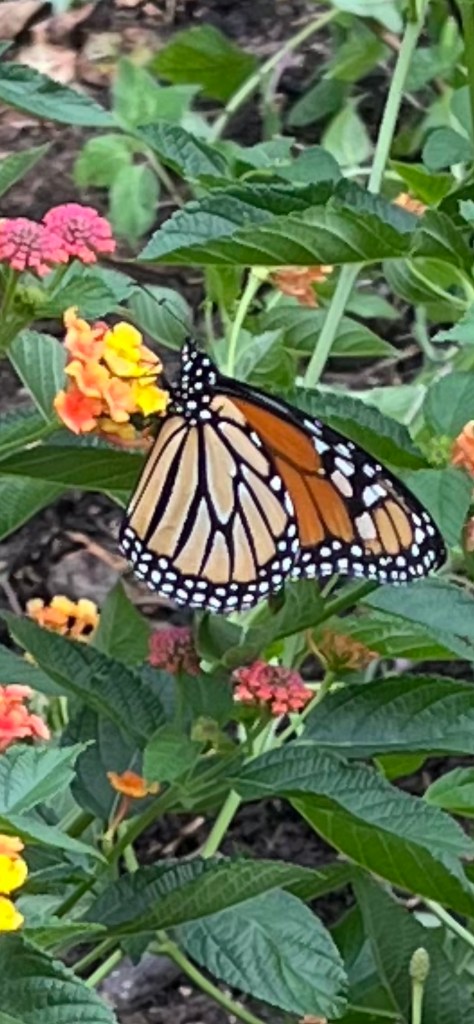
This last week however as I was walking through my yard, and I noticed something I hadn’t seen in years, monarch butterflies. I am not the only one noticing their presence. Surprisingly, the number of monarchs observed across the country is the highest level seen in over 20 years! Scientist don’t really know why such a steep recovery, but all gardeners will take it. They are so delicate and beautiful. What a welcome reminder on how much they have been missed in my garden.
They’re not afraid of humans so I got really close and observed them probing one flower at a time. Here is my favorite photo as one sits on a flowering lantana.
Hopefully, this fall you have a chance to walk through a nearby garden and get to watch the monarch flutter and bounce from flower to flower. What a wonderful sight!
 Big Daddy's Blog
Thanks for this great post, and for the shout out to the IUCN (fantastic organization). So glad to see the Monarchs back. I am sure they are loving your garden!
LikeLike