
People

Is The “American Dream” Still Alive? Ask Herman

I know that our country has many deep-rooted problems that, in many ways, are the severest that I have seen over my 60 or so years living in America. However, to others, the “American Dream” is still a real thing which they can turn from just a dream into reality. This is the story of one of those people.

But first a little history lesson before I tell you Herman’s story. After WWII, there was a huge influx of immigrants from all over the world coming to America to start a better life. It was assumed that as long as you were willing to work hard, it didn’t matter how much money you had or the level of education you had achieved – the “American Dream” could become a reality. However, immigrating into the United States today isn’t like it was in the 1950s. We found out that it is really hard to do. Moving fast forward to today, opportunities for immigrants or any people with little means to achieve the “American dream” has become just that – an unrealistic fantasy. However, with lots of hard work, perseverance, and a little luck, for some, it can still come true.

Back in 2016, my wife, the co-founder of a not-for-profit organization, needed some web design and overall technology help. She has always been a very inclusive person and read resumes from people all over the globe without discrimination. She simply chose the one that seemed most qualified after corresponding with them, and then they could work remotely, regardless of where they lived.

One of the respondents that my wife really liked was a man named Herman, who lived in a small rural town in Uganda called Lugazi. Lugazi, Uganda? Yes, Lugazi, Uganda.

They began a dialogue on the things that she needed help with, and Herman from Uganda had all of the answers. Unbeknownst to my wife at the time, Herman had to walk outside his mother’s home and stand in the middle of a dirt road to make the high speed connection reception possible.

As time went on, Herman became an integral part of the organization and expressed his interest in visiting the United States. In fact, he shared with my wife that it had always been a dream of his, as well as many other people in his country, to visit the US. He believed that the opportunities available in America far outweighed his chances for advancement in his home country.

My wife and Herman started devising a plan to bring Herman to the United States. Herman had already searched the Catholic Volunteer Network for a one-year faith-based volunteer opportunity and found an opening in Cincinnati, Ohio, that lasted for 12 months. He applied and received a B1/B2 visa, which allows foreigners to stay in America for activities such as tourism, visiting family members, and volunteering at not-for-profit organizations. However, there was one catch: Herman had never flown on a plane or left his hometown, let alone the country. Pretty scary stuff.

My wife told me about Herman and wanted to help him come to America so we arranged to buy him a plane ticket that would send him from Uganda, to Ethiopia, to Dublin, to Chicago and then finally to Cincinnati. It took him 26 hours. Quite a first time trip!

The day he was leaving from home, we told him that everything was in order and advised him to arrive at the airport plenty early because you never know what things could happen that could potentially hinder him from boarding the plane. Fortunately, he followed our advice because, since he was returning on a different airline, Ethiopian Airlines detained him as he couldn’t provide proof of booking a return flight. Luckily, just before they were going to close the doors without him, he found an email from me that showed his returning flight. As a result, they allowed him to board the plane.

Several months later, I’ll never forget my first impression the first time we met during the Thanksgiving holiday in St. Louis, Missouri. There was a rather shy and humble, intelligent man who had made the bold decision to fly halfway around the world in an attempt to improve his life and be a part of something that improved other people’s lives too. On the night of his arrival, we took him to an Italian restaurant where he shared stories about the stark contrast between our lives here and what he was accustomed to back home. It was so enlightening to get a glimpse of how different our daily lives were, yet we could connect and become friends in such a short amount of time.

The first place he lived in Cincinnati was with a group of volunteers who were also part of some international volunteer programs and began to get acclimated to his new surroundings. He thoroughly enjoyed his work there, but there was one obstacle: the program was only for a year. Despite this, Herman was determined to make America his permanent home and never return permanently to Uganda. However, as we soon discovered, achieving this was far from easy.

There were numerous hurdles that Herman had to overcome to stay in America, too many to list. The first one was probably the most harrowing. After Herman expressed his desire to stay in America, we discovered that the only viable option was for him to enroll in a university. Since he had always dreamed of getting a college degree, it was a perfect fit. However, before he could do that, he had to complete his internship program by flying out of the country and obtaining the necessary approval from the United States embassy in Uganda for his educational visa, allowing him to return to the US. Fortunately, this process went smoothly, and Herman successfully enrolled in a small community college in Cincinnati, with a focus on completing some computer science courses and then transferring to a small university in Cincinnati to pursue a degree in software engineering. We learned that as long as Herman remained enrolled in school, he would be able to stay in the country.

Even though we covered his tuition fees, Herman still had to find a way to finance his room and board expenses. To this day, we aren’t sure are not sure exactly how he managed to do it, but he did. He lived with a host family for a couple of years and also started working on campus. Unfortunately, due to his status as a foreign student, he was not permitted to seek employment off-campus. I’m not sure why this restriction exists, but it is indeed the law. How dumb is that?

Everything was going well in school, but in his eyes, his greatest achievement came in 2021 when Herman successfully passed his driver’s license test and was gifted an 2009 Chevy Saturn. He was incredibly thrilled and had never even considered the idea of owning a car before, as nobody in his family back in Uganda had ever owned one.

He began to excel in school and set a goal to graduate in 2023. However, some of the required classes for his degree were only offered once a year, which extended his graduation date by two semesters. This also meant that his graduation timeline would be prolonged by a year, but we had only agreed to cover his tuition for four years. We informed him that he would need to find a way to finance his final year of education. And guess what? He did. The US government offered a program for non-US citizens that allowed them to work off-campus in economic hardship situations. Herman needed us to provide a letter confirming that we would cover his tuition if he was unable to find a job, which he then submitted along with his application. To our delight, the government approved his application! Herman was now able to complete his degree by the spring of 2024.

That brings us to the present day. Just a few weeks ago, Herman graduated with a bachelor’s degree in a computer science related major. What an accomplishment. He didn’t have time to celebrate because he needed a job right away and wasted no time in applying to a marketing company. This particular company was in need of a software engineer to ensure the smooth operation of their website. In addition to his resume, they requested a referral from someone who could vouch for Herman’s abilities. Luckily, this was a simple task as my wife promptly picked up the phone and gave him a glowing recommendation, emphasizing what an incredible individual they had the chance to hire.

What a remarkable journey Herman has had in the past 8 years. He went from being a stranger who expressed interest in volunteering for an organization in St. Louis, Missouri, through contact with a woman he had never met, to someone who now has the chance for a full-time technology job in America. Herman was hired as a three-month intern, with a high probability of a permanent position. Herman’s quest to obtain permanent residency is far from over, but getting a permanent job in the US would be a tremendous step forward. I’m confident that whatever Herman puts his mind to, he will get it done.

There are many other heartwarming stories I could share about Herman, like his budding love of photography or his passion to dance, but this post has already become quite lengthy. However, I would like to leave you with one important thought: perseverance and hard work can still lead to the realization of someone’s hopes and dreams, no matter how impossible they may seem. Herman’s journey is a testament to the fact that the American Dream is still very much alive. You just have to put your head down and go for it.

Herman, thanks for reminding us of that and congratulations. We can’t wait to see the next chapter unfold in your amazing journey!
Standard
Life Lessons

The Littlest Things Make Life Worth Living

This will probably be the shortest post I have written to date, but maybe the best. This past week, four small, different things happened to me over several days that make life worth living.

The first occurred when I got to spend a couple of days with my youngest, playing golf together as team partners. It didn’t matter how we played; what mattered is that he wanted to spend that time with his dad. It was a ball!

The second occurred on Mother’s Day when my daughter’s family came over to swim. She gave my wife the most touching card, explaining what a wonderful role model she is as her journey as a new mom begins. I was so touched.

Thirdly, having just recently returned from a two-week trip to Japan with our two boys and our new daughter-in-law, we received the most heartfelt thank you note from the newlyweds. It was short and sweet, not just thanking us for taking them on the trip, but also explaining how special spending two weeks with us was the best part of the experience.

Finally, the shortest and most surprising thing happened as I was walking our 3-year-old granddaughter to her dad’s car. She said, “Poppy, can you give me a hug and a kiss?” She went on and said, I want a little kiss and a big hug!” It was just one little sentence that made my day.

All of these things are so trivial in one’s life, yet to me those are the moments that make it worth living!

What were the small things that happened to you recently that made life worth living?

Standard
People

The Great Debate: To Use or Not to Use the Auto Feature of Your Car’s HVAC System? That is the Question…

This question has been bugging me for some time now, and I thought to myself, “Okay, I’ll write about it on my blog.” It’s interesting how a seemingly simple topic like using the auto feature of a car’s HVAC system can elicit such strong and varied opinions. It just goes to show that even the most seemingly straightforward decisions can have different perspectives and considerations even though I think there is nothing to debate at all.

Let me set the background. You get into your car in either the heat of the summer or the frigid cold of the winter and you want the temperature in the car to change as quickly as possible. What do you do? Here the arguments for the two sides of this heated and important issue. But first a little background information.

A Primer on a Car’s HVAC System and the Great Debate:

The auto feature on a car’s HVAC system is designed to automatically control the temperature, fan speed, and airflow based on the desired temperature set by the driver. Some argue that using the auto feature provides convenience and ensures a comfortable driving experience without the need for constant adjustment. On the other hand, some believe that manually adjusting the settings allows for more control and customization.

Auto Or Manual?

One possible reason for the divergent opinions could be personal preference and individual comfort levels. Some people may prefer a consistently controlled and automatic climate inside their car, while others may enjoy the flexibility of adjusting the temperature and airflow according to their immediate needs.

Additionally, the climate and weather conditions in different regions can also play a role in the decision. In extreme weather conditions, such as very hot or cold temperatures, it may be more beneficial to manually adjust the settings to quickly achieve the desired temperature.

Before I give you my “two cents” on the subject, let’s delve a little deeper into the positions of the two sides of the debate.

Pushing the Fan Button Manually:

While the auto feature of a car’s HVAC system offers convenience and benefits, some individuals may still prefer manual control for the following reasons:

  1. Customization: Manual control allows individuals to have precise control over the temperature, fan speed, and airflow. They can adjust these settings based on their personal preferences and comfort levels, tailoring the HVAC system to their specific needs.
  2. Instant Response: Manual control allows for immediate changes in the HVAC settings. Some individuals may prefer to have full control over the system and make quick adjustments as desired, without relying on the auto feature to gradually adapt to the changes. Why would the car company’s put a “low” setting or a “high” setting on the temperature gauge in the car if it didn’t give the driver the maximum output?
  3. Sensory Feedback: Manual control allows individuals to feel the changes in temperature and airflow directly. Some people find this sensory feedback helpful in gauging the effectiveness of the HVAC system and making adjustments accordingly.
  4. Personal Preference: Some individuals simply prefer the sense of control and involvement that comes with manually adjusting the HVAC settings. They may enjoy the process of finding the perfect temperature and fan speed combination that suits their preferences.

Ask the Experts:

I know nothing about cars so I began to see if I could search on line for some expert opinions.

I found this article on a web site called “Broken Secrets” written by a cat who rebuilds cars for a living. He explains that putting the fan on high to heat up the car slows the heating process down rather than just leaving the thermostat on “Auto”. If you want more information go ahead and open the link below.

Warm Your Car Up Faster

Ok so is the answer different when it comes to cooling off the car on a hot summer day? The answer is “yes”, maybe a little. The higher fan speed might get the car a little cooler faster but the “Auto” feature should do the job for you in a timely fashion.

Consumer Reports composed a you tube video on the subject and here is the link:

Finally, I shared a link to a very comprehensive article on the subject. Who would have thought there would be so much written on such a trivial matter? I can understand if there were numerous articles on how to solve world hunger or create world peace, but AC settings in a car? It just shows that some people might have too much time on their hands.

https://storables.com/articles/what-does-auto-mean-on-ac/

My Two Cents: Use the Automatic Thermostat Feature on Your Car and Set it and Forget it:

It has never made sense to me to ever change the fan speed in my car manually. Why would the car companies offer the auto feature if pushing the fan speed button manually is more effective? There are some reasons, but I believe they are rather lame, for not using the “auto” feature in the car. Therefore, I am going to remain an “auto” guy.

Vanilla or Chocolate?

Now that I have shed some light on this very important debate topic, I can now spend my time on more important issues, like determining which flavor of ice cream is the best: vanilla or chocolate. I can delve into that “hot topic” another time!

Thanks for reading!

Standard
Life Lessons

When Life Really Tests You

Frank Sinatra, the legendary “blue eyes,” sang a song in the 1950s that became one of his biggest hits called “That’s Life.” The song delves into the highs and lows of a person’s life, encapsulating it with the simple phrase, “That’s Life.” The challenges and difficulties that come with the ever-changing landscape of one’s life can be more overwhelming for some individuals than others. In this blog post, I aim to shed some light on this topic.

Change. If there is one word that makes me cringe, it is “change.” I have never been a fan of change. In fact, during my 40s, I vividly remember having conversations with my friends where I would exclaim, “People never change.” I firmly believed that while people may act differently on the surface, deep down, they remain the same person. As a result, I did everything in my power to resist change, never truly accepting the fact that I too would have to change. It was simply easier to maintain the status quo. However, I have recently come to realize that this belief can be misguided and inaccurate, and accepting this has been a difficult pill to swallow. This mindset has not only taken a toll on me mentally but also physically, dampening my enthusiasm for writing in this blog. However, that changes now.

Just like the saying goes, “time never stands still,” it is equally true that people truly do change. One can choose to adapt and embrace the ever-changing landscape, striving to become a better person by respecting it, or one can resist and fight against it to the point of self-destruction. For a long time, I fought against change, convincing myself that it was merely a passing phase or something that I could navigate through effortlessly until things returned to normal. However, I have come to realize that this is not the case. Change is an inevitable part of life.

Will I emerge as a better person on the other side? I certainly hope so. One thing I am certain of is that changing one’s way of thinking and behaving becomes increasingly challenging as we grow older. I never imagined that at the age of 62, I would have to adapt the way I communicate and organize my life. I always believed that things would continue to be smooth sailing, as that was the pattern of my life for the most part. I never really embraced the phrase “That’s Life” because I believed that the major ups and downs in life only happened to others, not to me. However, over the past few years, that notion has been proven wrong. Life has truly tested me.

This is still a work in progress that I am navigating on a daily basis. It requires a great deal of reflection and effort to retrain one’s mindset. However, given the high stakes involved, I am confident that embracing these changes will ultimately make me a better person. I cannot recall a time when life has tested me to the core like it has recently. I understand that everyone faces tests at different points in their lives, and my time is now. I firmly believe that I will emerge from this experience as a stronger individual. In the words of Frank Sinatra’s poignant song, “That’s Life,” it is the very nature of life’s ups and downs that will make the good times even more precious.

Standard
People

Going Forward Being Jewish Will Never be the Same Again

I’m going to give a lot of disclaimers before I write this post so you can understand where I’m coming from.

Here is the list:

1. I am not a political person.

2. The religious aspects of being Jewish has never been important to me.

3. I like the cultural side of Judaism but that is as far as it goes.

4. I have skipped going to high holiday services to play hockey with my friends.

5. I have never thought of myself as a minority,

6. I have always thought of myself being an American more than being Jewish.

I can’t believe I’m writing a post about the rise of anti-Semitism in the United States. The tipping point for me occurred two days ago when emails were sent to three synagogues in St. Louis, threatening to blow them up. This happened in the neighborhood where I grew up – a nondescript middle-class Midwestern area of St. Louis where being Jewish was never a factor.

Growing up in a city like St. Louis, being Jewish was not a big deal. I was just another kid, no different from anyone else in my class. Yes, I did go to Sunday school, but my non-Jewish friends didn’t think anything of it. We were simply American kids growing up together. Religious differences were never discussed because they simply weren’t important. While this may not be true in other parts of the country, in St. Louis, Jewish people assimilated seamlessly into society. I can’t recall a single instance during my upbringing where I or anyone I knew experienced any anti-Semitic remarks. It simply didn’t happen.

So what’s changed?

Nothing really except that time marches on and history tends to repeats itself. Let me explain…..

One aspect of human history that I wholeheartedly believe in is the repetition of events. Unfortunately, our lifespan of around a century is not long enough to fully learn from or remember lessons of the past. The past remains a distant memory that seemingly has no impact on our present lives. However, as I mentioned earlier, history does tend to repeat itself, and there may come a time when being Jewish is once again viewed negatively.

Throughout human history, the “majority” has consistently persecuted the minority due to their differences. People often believe in their own superiority over others. From the Greeks, Vikings, Romans, Crusaders, Chinese, Turks, Russians, British, Germans, Japanese, to the Americans, all have targeted minorities in order to further the interests of the prevailing majority in power. Minorities have always been convenient scapegoats.

Jewish people have been repeatedly targeted throughout history, although not in my lifetime. It has been almost 100 years since the Holocaust, and most of the survivors have passed away. While my children are aware of it, they view it as a distant event that did not directly impact them, as they rarely consider being Jewish as something different.

With all the recent upheaval in the world, it’s astonishing how much things have changed. I won’t assign blame for these changes as that is beyond my expertise, but I can attest to their dramatic nature. For the first time in my life, I feel like a minority, where my religious beliefs single me out. I never thought in a million years that I would be saying this in my lifetime. Unfortunately, I fear that the rise of antisemitism will worsen before it improves.

I’m not one of those “doomsayers” who believe that the Holocaust could happen again. It’s not that extreme, nowhere near that extreme. However, I do wonder how it will impact the next generation of Jewish people in America. Will they face job discrimination because of their Jewish identity? Will they be denied admission to certain schools because they are Jewish? I sincerely hope not. As of now, I don’t think that’s the case, but the current trend is certainly concerning.

My kids and grandkids will be growing up in a world that is quite different from the one I am familiar with. The term “antisemitism” wasn’t even part of my vocabulary. I don’t have any solutions or profound thoughts on how to address this situation. However, these are the facts that I encounter on a daily basis. Life is already challenging, and the thought of additional obstacles for my kids and especially my grandkids fills me with apprehension. I believe they will be okay because they are growing up in a somewhat sheltered environment that shields them from most of it. Nonetheless, it doesn’t change the fact that they may still face discrimination because of their Jewish identity, and that makes me sad.

Standard
Life Lessons

The Word “Hard” is Underestimated

How many times in your life has someone told you that something was going to be hard? Quite a few I bet. As a child, probably one of the first times I was told something was hard could have been learning to ride a bike. I can remember my dad telling me that it’s not easy to learn to ride a bike right away. I really didn’t know what he meant until I continually fell off my bike and skinned my knee. That was not fun. I started getting a glimpse of what the word “hard” meant.

Then, as a child, the next challenge for many of us, including myself, was school. There were so many facets that made school hard. It started with trying to make good grades. That was always a “thing” in my house growing up. Getting good grades was very important. Sometimes, it was too important because there were some classes, like Geometry, that I just didn’t get. It didn’t matter to my parents though because I was supposed to get an “A” no matter how hard the class was for me to comprehend. That wasn’t the best way to help a child’s self-esteem.

Another facet of something that can be hard growing up was making friends. Wow, can that be hard for some kids. It was never hard for me, but I bet for a shy kid, making friends was very gut-wrenching. I bet they got a real appreciation for the word “hard” in a hurry. I can’t imagine how hard that might have been for them.

As we get older, the depth of the consequences of successes and failures becomes more important, so the word “hard” takes on more meaning as well. In most people’s lives, high school is more important and harder than middle school, college is more important and harder than high school, and so on. Each of those milestones is different and important, but the word “hard” really hit home when I started my first job out of college. People who were already in the workforce would tell me that work was hard and very different from school. It took me a while to understand what they meant. I guess for me, I began to understand how hard work was going to be when I realized that this was it. There was no next step. I would be working in some type of job for many years to come. That was so hard to comprehend, that I would be working day in and day out for years. Some of the innocence of my youth began to be chipped away. Unbeknownst to me at that time, it was only the beginning.

There can also be nuances in the definition of the word “hard” that took me a long time to understand. When I was in my 20s and 30s, I was so judgmental of people and the whole world itself. “Gray” wasn’t part of my vocabulary; everything was black and white. Eventually, bigger things began happening in my life and the nuances of the word “hard” began to unfold. The first was marriage. I got married at a young age and people would tell us how hard marriage can be. I really never understood what they meant until I had been married for a while, and I don’t completely agree. Marriage is hard only if you value your relationship as the most important thing in your life. It’s not very hard if you put in the same amount of work into it as, let’s say, staying or trying to excel in your career. There is a nuance to the word “hard,” and it depends on one’s values and priorities. Marriage is hard because it’s important to me, but to other people, maybe not so much. I used to be so judgmental on this issue, but not anymore. I have learned that everyone goes about living their own life, and they are living by a different set of priorities than me. That doesn’t make them a bad person.

Now, being in my 60s, I have experienced many difficult times in my life. However, nothing prepared me for losing a parent and my best friend. My wife, too, had already lost both of her parents before I lost my dad, and I was there to console her and provide support. I would tell her how sorry I felt and how “hard” it must be to lose a parent. I never truly understood the meaning of loss until it happened to me. That’s just the way life goes because until something like that happens to you, it’s hard to comprehend how it truly feels.

Ok enough talk about sadness. There is a silver lining when describing the word “hard”. Sayings with the word “hard” in it have been told to me and it has been written about time and time again by people much wiser than myself.

Here are some sayings written by some very famous people who have used the word “hard” to guide them through their lives.

Success is no accident. It is hard work, perseverance, learning, studying, sacrifice and most of all, love of what you are doing or learning to do.” — Pele, Brazilian soccer player

You can’t get there by bus, only by hard work and risk and by not quite knowing what you’re doing. What you’ll discover will be wonderful. What you’ll discover will be yourself.” — Alan Alda, actor

If you really look closely, most overnight successes took a long time.” — Steve Jobs, co-Founder of Apple Inc.

All our dreams can come true, if we have the courage to pursue them.” — Walt Disney, founder of Walt Disney World

I hope you enjoy reading my blogs as much as I sure enjoy writing them. Have a great holiday season and a happy and healthy 2024!

Cheers!

Standard
Life Lessons

A Clean Slate

I haven’t posted anything in a while, and I’m not sure why. Sometimes I just don’t have anything to write about. However, that changed yesterday when I was on our Peloton bike and the instructor said something that really resonated with me. She mentioned that every new morning is like a clean slate, allowing us to forget what happened the day before and start afresh. This concept of a clean slate really struck a chord with me. It reminds me of springtime or newborn babies, when everything feels fresh and new. Nature is the true expert when it comes to a clean slate. During spring, especially in areas with four seasons, plants and trees get a clean slate. All the imperfections that were visible last year have vanished with new growth.

The timeline of a clean slate in someone’s life doesn’t have to be on a daily basis. It can be over a longer-term. You could be starting a new job, getting married, or moving to a different city to start over again. I like the idea of starting over every day. The big things in my life for now are pretty stable. I’m still healthy, my wife still loves me, I have amazing my kids and grandkids, and most of the time I still like my job. However, there are still plenty of demons that roll around in my head from time to time. I know pretty much everybody has things going through their brain that give them trepidation and worry. It’s how we learn to deal with them that makes one a present and productive person.

It would be idealistic to believe that someone can follow a predictable routine and experience the same emotions every single day. As humans, our emotions naturally fluctuate, ranging from periods of anxiety or frustration to moments of euphoria, all of which impact our daily lives. Trying to level out these highs and lows has been a lifelong pursuit for me, albeit with mediocre success. From an outsider’s perspective, I might appear to be in complete control, but internally, my mind can race at a million miles a minute. The idea of waking up to a clean slate each morning is so liberating to me.

One of the greatest ways to make use of a new day is to get out of bed and take a moment to appreciate all the things that I should be grateful for, even if I tend to take many of them for granted. The act of being grateful is often overlooked and underappreciated. How often do you pause and reflect on all the things you are grateful for? If you are like me probably not enough.

I have previously mentioned that one of the benefits of getting older is that young people often seek my advice on various issues they are currently facing. Selfishly, it gives me a moment to reflect and assess if I am actually living by the advice I give. Hopefully, it’s not just empty words, and I can truly listen to my own guidance and become a better partner to my wife and to the people I encounter in life. Sometimes, I succeed in doing so, and other times, not so much. The concept of a clean slate resonates with me. It brings a sense of purity and upliftment. Regardless of how terrible a day has been or how poorly I may have treated someone I care about, the next day offers a fresh start, a new beginning on a clean slate. I understand it may sound simplistic, but it can become anyone’s reality if they truly believe in it. Because when your mind believes it’s true, you’ve already won half the battle. Your own mind will position you to have a clean slate and will guide you to become a better person. Give it a try!

Standard
Nature

The Monarch Butterfly is Making a Comeback

One of the most striking and beautiful butterflies in my garden is the monarch. The size and color of their wings is so striking. You cannot miss them as they fly from flower to flower, sucking up nectar to gain strength before they begin their long migration back to Texas, Oklahoma, and Mexico in late fall. Sadly, I have noticed over the past several years they have been missing. Vanished. I’m not the first to be aware of their noticeable disappearance.

On July 21, 2022, the International Union for Conservation of Nature (IUCN) placed the migratory monarch (subspecies D. p. plexippus) on the IUCN Red List of Threatened Species, listing it as endangered, and noting that its primary threats are habitat destruction and climate change. The IUCN is an international group of government and civil society organizations headquartered in Switzerland. Announcing the decision, the IUCN noted that the migratory monarch, “known for its migrations from Mexico and California in the winter to summer breeding grounds throughout the United States and Canada, has shrunk by between 22% and 72% over the past decade. Legal and illegal logging and deforestation to make space for agriculture and urban development has already destroyed substantial areas of the butterflies’ winter shelter in Mexico and California, while pesticides and herbicides used in intensive agriculture across the range kill butterflies and milkweed, the host plant that the larvae of the monarch butterfly feed on.”

In its announcement, the IUCN continued: “Climate change has significantly impacted the migratory monarch butterfly and is a fast-growing threat; drought limits the growth of milkweed and increases the frequency of catastrophic wildfires, temperature extremes trigger earlier migrations before milkweed is available, while severe weather has killed millions of butterflies.” The IUCN noted that eastern and western populations are both in trouble. “The western population is at greatest risk of extinction, having declined by an estimated 99.9%, from as many as 10 million to 1,914 butterflies between the 1980s and 2021. The larger eastern population also shrunk by 84% from 1996 to 2014. Concern remains as to whether enough butterflies survive to maintain the populations and prevent extinction.”

This last week however as I was walking through my yard, and I noticed something I hadn’t seen in years, monarch butterflies. I am not the only one noticing their presence. Surprisingly, the number of monarchs observed across the country is the highest level seen in over 20 years! Scientist don’t really know why such a steep recovery, but all gardeners will take it. They are so delicate and beautiful. What a welcome reminder on how much they have been missed in my garden.

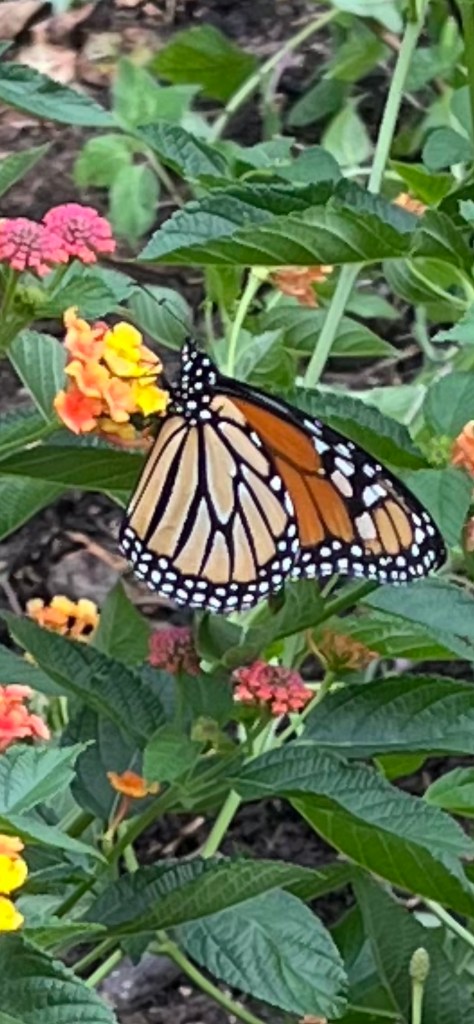
They’re not afraid of humans so I got really close and observed them probing one flower at a time. Here is my favorite photo as one sits on a flowering lantana.

Eastern Monarch Butterfly

Hopefully, this fall you have a chance to walk through a nearby garden and get to watch the monarch flutter and bounce from flower to flower. What a wonderful sight!

Standard
Life Lessons

Mentorships Go Both Ways

For one reason or another, I have stayed very close to some of my kids’ friends. I guess they look at me as a mentor in some aspects of their lives. However, the surprising thing is that they have become mentors to me too. That’s a good thing because everyone needs mentors.

Let me elaborate. Mentors come in different shapes and sizes at different times in one’s life. As a child, the first mentor I can remember was in my sophomore year of high school. Dr. Bill Heyde didn’t just teach social studies; he was incredibly passionate about all of the students’ lives he touched. He invited us to come over to his house in the summertime and talk about what was going on in the world. He would always chaperone us on various field trips and call us all “great Americans.” He taught me to be a positive person and always see the best in people. What a great way to go through life!

Fast forward to when I was 24 years old and about to start my first job out of college. I was getting married later that year and had no idea what was expected of me as a new stock broker. So, I decided to sit in the office of one of the biggest producers every morning and just listen to how he talked to his clients. This experience was invaluable. Mort became my mentor at work. He would talk to me about the attributes needed to be successful, not just at work but also in life. (On a different note, one of the biggest negatives resulting from COVID is the lack of time new employees get to just listen and be mentored by seasoned professionals in the office.) Mort was part of my life for over two decades, and I am so grateful for the time we spent together. As his career wound down, he would call me and ask questions on different subjects. In a small way, I was able to be his mentor. Mentorships can surely go both ways.

The first time I had the opportunity to mentor someone at work was purely by luck. I was 29 years old and my career was starting to take off, so Charlie, my office manager at the time, asked if I would join him on a recruiting trip to the University of Texas at Austin. I agreed, and we went to Austin to interview prospective job candidates from the business school. Since I had no experience with interviewing, my questions were mostly focused on why the candidates wanted to be financial advisors.

One candidate stood out from the rest, and eventually Charlie offered him a job in my office. I always tell people that I stopped interviewing potential employees after Charlie hired Scot because no other candidate could have done better than Scot. I was “batting a thousand” with hiring Scot, so I figured I should quit while I was ahead!

Scot would come sit in my office, and I became his mentor, just like Mort was to me. It’s a role that I cherish to this day because, in addition to being his mentor, we have become great friends. Fast forward to today, besides being one of the most successful financial advisors in the country (way surpassing me!), he has become my mentor in so many aspects of my life. Mentorships can certainly go both ways.

In many families, a parent, sibling, or close relative can be an important mentor in a young person’s life. Probably my father was the closest thing to being a mentor while I was growing up, because he taught me that working hard and always striving to do your best are cornerstones to a successful career. Yet, I wouldn’t call my dad a mentor. In fact, since I was the oldest child in my family, I have been looked upon as the most responsible, thus at times a mentor to my siblings, especially my brother. There have been times in his life when he has needed advice, and I have been the one he has turned to. Recently, though, the roles have reversed; now I go to him for advice, and he sometimes gives me guidance when he thinks I’m going astray. What a nice change! Mentorships can certainly go both ways.

I began this post by stating that I’m still very close to some of my kids’ friends even as adults. Am I some of their mentors? Maybe a little. I think to be a mentor to your kids’ friends, you have to be looked upon in a positive light by your own children first. There are many fine attributes I have taken from my parents, but as I became a father myself, I wanted to be a better dad than my father was to me. Mentoring my kids, or at least being a role model to the best of my ability, was and still is at the top of the list. Obviously, this is something I could never do by myself. In our home, successfully parenting our kids has been a collaborative effort between me and my wife. In fact, there are so many areas that my wife has mentored me on how to be a better parent and also just a better person as we go through our journey of life together. Thanks, honey!

There are always ways to grow as a person, no matter how old you are. So many people, including my kids’ friends, mentor me in particular areas of my life that I didn’t think were possible. I would like to think that I am open enough to use their guidance to my benefit. Sometimes, it isn’t very easy to do because, as someone older, I often feel like I know better. But that’s wrong! I should know better because mentorships go both ways.

Standard
Nature

Daisies-The Perfect Perennial Flower

The Daisy

A Quick Plant Tutorial:

Before I explain why the daisy is my favorite flower, I want to clarify a couple of gardening terms that often confuse people. There are two main types of flowers: perennials and annuals. Both have their place in the garden for different reasons. Unless you live in a temperate climate, annuals are flowers that need to be replanted every year. This group includes popular varieties like marigolds, impatiens, zinnias, and geraniums. They are planted in the spring after the last frost and bloom profusely until the first frost in the fall, when they die. On the other hand, perennials come back every year, which is why they are called perennials. They are my favorite type of flowers because once you plant them in the correct spot, they will grow and multiply. Some common perennials include cone flowers, bee balm, peonies, black-eyed Susans, and daisies. However, perennials do not flower all summer like annuals. Once they are done blooming, they are finished until the following year. That is why it is important to plant a variety of perennials that bloom at different times, so you have flowers blooming all summer.

For the amateur gardener, the search for easy-to-grow flowers is always a challenge. I have tried so many varieties and seen many of them wither and die. At first, I would only plant annuals because they were easy to grow and they flowered all summer. However, I eventually grew tired of replanting them every spring. I wanted to have flowers that would come back every year and flourish. After a lot of experimentation with different perennials, the daisy has become my go-to flower!

The Daisy:

Bellis perennis (/ˈbɛləs pəˈrɛnəs/), the daisy, is a European species of the Asteraceae family, often considered the archetypal species of the name daisy. It can generally be grown in full sun to partial shade conditions, and requires little or no maintenance. It has no known serious insect or disease problems and can usually be grown in most well-drained soils.

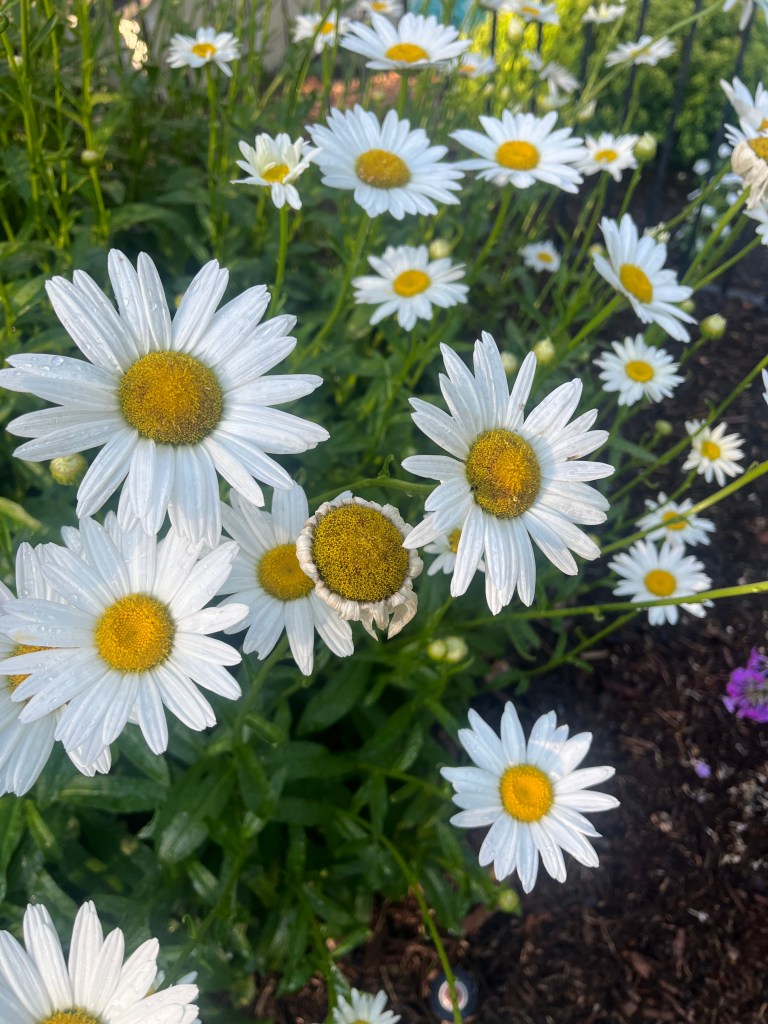
I have them all over my garden. I love the way every year they pop up from the beginning of May, and by the middle of June, the buds are about to burst open and expose these beautiful, perfect white blossoms with an explosive yellow center. The multiple layers of the white petals are mostly symmetrical, yet each one is unique. Once they bloom, they will keep on blooming from the middle of June until the end of August, which is a very long time for a perennial. They are also my favorite cut flower because they last at least a week once they are put in a vase.

The Plant That Keeps on Giving

Daisies are the easiest plants to separate. All you need to do is use your handy dandy shovel and pick a spot in your daisy patch, then push your shovel into the ground to separate the daisy plants. Then, take the separated piece and plant it in a different place in your garden. You just got a new plant for free!

There aren’t many things in the world that gets me more enjoyment than walking in my yard and observing the flowers in my garden. No plant gives me more joy than the daisy. They are so easy to grow. Go ahead and throw one into the ground and start your own love affair with the daisy!

Standard